News
Obin AI Brings Production-Grade Financial Agents to Google Cloud's Gemini Enterprise for Financial Services
Brandon Redlinger
•

New York, NY, August 25, 2026 — Obin AI, an enterprise AI company that builds agentic solutions for financial institutions, today launched new industry-specific AI capabilities built on Google Cloud’s Gemini Enterprise for Financial Services to automate complex enterprise workflows. The Obin Financial Agent is available to Gemini Enterprise customers.
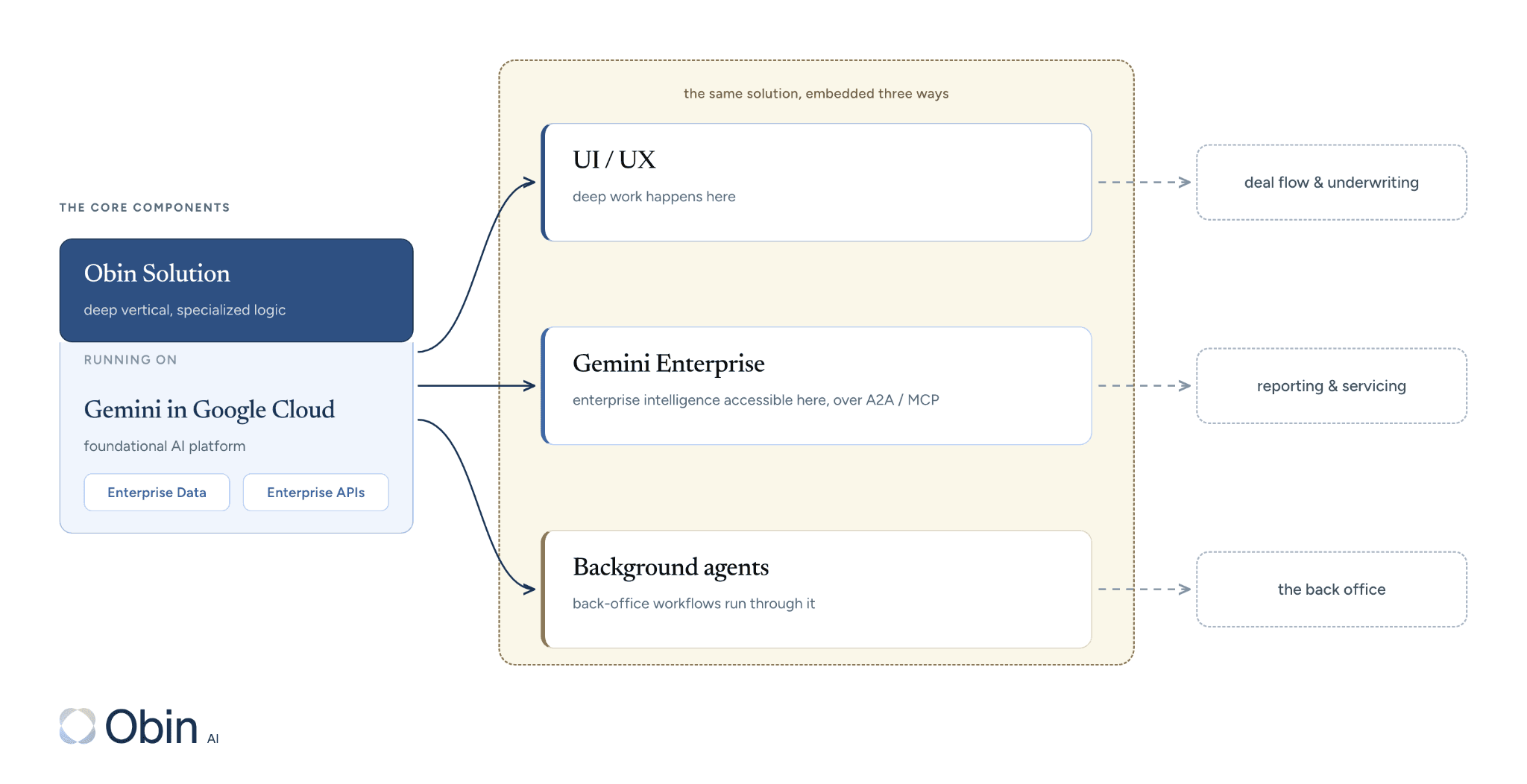
Large financial institutions are now judging AI initiatives on firm-wide adoption and ROI. Returns arrive when agents run inside the infrastructure a firm already operates, within its existing controls and on its own data, handling edge cases and producing a record an auditor can follow months later. Obin’s solutions run on Google Cloud and expose their agents over the Agent2Agent (A2A) protocol, so a firm’s business users reach those agents from Gemini Enterprise without leaving the tools they already use.
What that looks like in insurance
At one of the largest life insurers in the United States, an advisor managing a book of clients used to work across dozens of systems. None of these systems talked to each other, and it was difficult for advisors to determine which client needed attention today. The expertise of the firm’s best advisors sat in silos and rarely reached the advisors who needed it.
Obin built the firm an agentic application that runs inside the carrier’s own environment, using Google’s Gemini models on Google Cloud. Advisors work in one place, delegate work to AI agents, and review what comes back, with ranked next actions across a book of thousands of clients. Obin also runs background agents on the back-office work, so meeting prep that took hours now takes minutes. Every output traces back to the data and the rules behind it, so the work runs inside the policies compliance already approved. Advisors spend their time with clients while the AI agents do the gathering.
Those agents are exposed over A2A, and that is where Gemini Enterprise fits. A business user in Gemini Enterprise can build a report or a presentation against the same live data and the same workflows that run the advisor’s day, so a view of the advisor pipeline shows the live data with the latest updates on clients’ policies, rather than numbers someone exported into a spreadsheet last week.
What that looks like in asset management
At a private credit fund with more than $500 billion in assets, the executive team demands a current view of risk across private holdings, which means reading and synthesizing more than 50,000 loan notices a year against their underlying agreements. Even a team that gets through that volume moves too slowly to act on what it finds, and every firm builds its own version of the process from scratch.
An Obin risk monitoring agent now reads each notice against the underlying credit agreement, validates it, posts it, and escalates only the exceptions that need a human decision. The fund has seen up to 90% time savings on the workflows that matter most.
At a debt fund with more than $10 billion under management, go/no-go calls that once took days now resolve in minutes with the use of Obin’s origination agent, roughly 70% faster to LOI and about $2 million in annual return.
“Gemini Enterprise gives financial institutions the ability to harness state-of-the-art AI directly where their data and governance already live,” said Satish Thomas, Vice President, Google Cloud. “Obin AI’s domain-specific agents leverage this enterprise platform so firms can deploy specialized, high-impact agentic capabilities across complex financial workflows while maintaining strict compliance boundaries.”
An institution already running on Google Cloud can access the Obin Financial Agent in Gemini Enterprise without moving its data. Obin is built on an open architecture, so institutions keep full ownership and control of their models, data, and intellectual property rather than handing them to a closed system.
“Financial institutions have no shortage of AI prototypes. What decides the return on investment is whether an agent can run on the infrastructure the firm already operates, on its own data and inside its own controls,” said Lak Lakshmanan, CTO and Co-Founder of Obin AI. “Building on Gemini Enterprise and Google Cloud means the agent runs on the same stack the firm’s engineers and business users already work in. That is what took the advisor workflow at the insurer from decision to production in weeks, and the credit workflows at the funds went live the same way.”
About Obin AI
Obin AI is an enterprise artificial intelligence company building the next generation of agentic intelligence for financial services. The company develops production-ready AI solutions that run defined workflows end-to-end inside a firm’s controls and audit boundaries, encoding institution-specific logic and producing traceable, inspectable outputs. Because of its open, no-lock-in architecture and ability to resolve even nuanced edge cases, Obin AI is trusted by global financial institutions representing over $1 trillion in assets under management. Founded by seasoned leaders from Google AI, JPMorgan and Silver Lake, Obin AI is reimagining how financial firms operate, deploying AI workers directly within live workflows to expand decision capacity under institutional controls.

News
Nov 24, 2026
Obin AI Joins Anthropic’s Claude Partner Network as a Select Partner
Financial institutions using Claude gain a partner built for regulated finance, with agents that run inside each firm’s own environment and are proven against its own source of truth before they are live in production.

Engineering
Nov 5, 2026
Your Data Isn’t Ready. Start Agentic Transformation Anyway.
You don't need to fix your entire data infrastructure before building useful AI agents. Start with a specific business task, establish the data definitions and controls it requires, and build from there. The article explores how shared enterprise context and managed MCP gateways can help organizations connect existing systems, reduce integration work, and develop reusable capabilities across agents. The key is to test real business outcomes, maintain human oversight, and measure value rather than waiting for perfect data readiness.